How High to Hang Art: The 57-Inch Rule and Spacing Over Furniture
Written by Mia Sutton Published on Topic: Decor, Interior Design
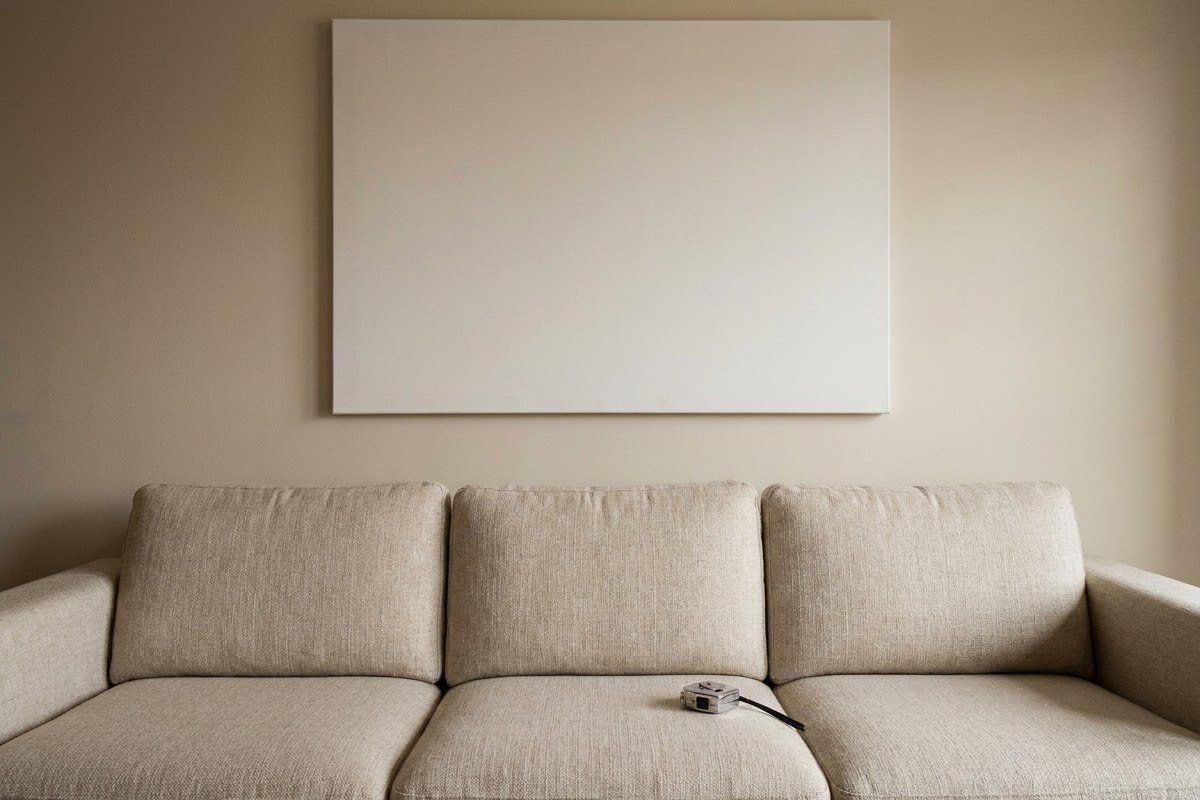
Hang art with its centre about 57 inches above the floor, which matches average eye level, and 57 to 60 inches in larger rooms. Over a sofa, bed or console, put the bottom of the frame 6 to 10 inches above the furniture. To find the nail, add half the art's height to the centre height, then subtract the drop from the top edge to the hanger.
From the guide: Hidden Storage Solutions for Minimalist Homes: Room-by-Room Guide
Art hung too high is the most common mistake in a refined room. This guide gives the convention, the spacing over furniture and the arithmetic for the nail. It belongs with our guidance on hallways and entries and storage-led layouts. For your own piece, use the art hanging height calculator.
How high should you hang art?
Centre the art about 57 inches above the floor. That is the “rule of 57”, which AS Hanging Display Systems, a hanging-hardware maker, describes as matching average eye level, and which galleries and museums use as a common reference. Better Homes & Gardens gives 57 to 60 inches, and up to 60 in larger rooms. It is a convention, so adjust it for tall furniture, low seating or a hallway.
The centre-height rule
Decide the centre height first, then convert it to a nail position:
- Top edge = centre height + half the art’s height.
- Nail (hook) height = top edge − drop, where the drop is the distance from the top of the frame down to the top of the taut wire or the hanger notch.
AS Hanging says skipping the second step is the most common reason art ends up too high.
Above a sofa, bed or console
Over furniture, space the art from the furniture, not the floor:
| Placement | Gap from furniture to bottom of art | Source |
|---|---|---|
| Sofa, bed, console | 6 to 10 inches (no more than 12) | Better Homes & Gardens |
| Sofa, bed, desk | 7 to 10 inches | Framebridge |
| Mantel | 4 to 7 inches | Better Homes & Gardens |
| Large furniture that looks heavy | move the art up 4 to 6 inches | Better Homes & Gardens |
Our calculator starts at 8 inches, the midpoint of the 6 to 10 inch range, and sets the centre from there. Over a low sofa the centre usually lands under 57 inches, and that is normal.
Groups and gallery walls
Both Framebridge and AS Hanging treat a gallery wall as one large piece: measure the whole arrangement’s height and centre that at 57 inches. For three frames stacked vertically, the middle frame’s centre sits at eye level. We found no published standard for the gap between frames, so choose one gap, keep it equal and mock up the layout on the floor or with paper templates before you drill.
Hallways, tall ceilings and seated viewing
- Hallways: Framebridge suggests hanging art a little higher, at 60 to 66 inches to the centre, because you see it standing and close up.
- Tall ceilings: do not hang art higher just to fill the wall. Better Homes & Gardens suggests keeping it at eye level at 10 feet and above, and adding pieces above an anchor if you want drama.
- Low ceilings: Better Homes & Gardens says art can sit a little nearer the ceiling in 7 foot rooms.
- Seated viewers: the Smithsonian accessibility guideline puts small items’ centre lines at no more than 40 inches. It is a museum guideline, which can inform a dining nook or reading corner.
Worked example 1: art on an open wall
A frame 24 inches high, with a 4 inch drop to the wire, centred at 57 inches.
- Half the height: 24 ÷ 2 = 12 in.
- Top edge: 57 + 12 = 69 in.
- Nail: 69 − 4 = 65 in above the floor. The art spans 45 to 69 inches.
Worked example 2: art above a sofa
A sofa back 34 inches high, an 8 inch gap, the same 24 inch frame and 4 inch drop.
- Bottom edge: 34 + 8 = 42 in. Centre: 42 + 12 = 54 in. Top edge: 66 in.
- Nail: 66 − 4 = 62 in.
Worked example 3: art in a hallway
A frame 20 inches high, drop 4 inches, centred at 63 inches (the middle of the 60 to 66 range).
- Top edge: 63 + 10 = 73 in. Nail: 73 − 4 = 69 in.
Nail position and hardware
Mark the hook point on the wall before drilling, and use two hooks for wide frames: the horizontal positions are the wall’s centre line ± half the distance between the hooks. Use anchors rated for the weight and the wall, and have heavy mirrors hung by two people. The calculator outputs the nail height, the centre line across a wall and two-hook positions.
Related
For the room as a whole, see our guide on designing a minimalist entryway and how visual anchors work in a minimalist room. The rule here matches the quiet restraint described in the art of restraint.
Your questions answered
How high should I hang a picture?
Hang it so the centre of the picture is about 57 inches from the floor. AS Hanging Display Systems describes 57 inches as average eye level, and Better Homes & Gardens gives 57 to 60 inches. It is a convention used by galleries, not a standard. Adjust for the room, the furniture and the people who live there, and measure from the finished floor.
How far above a sofa should art hang?
Put the bottom edge of the art 6 to 10 inches above the sofa back, according to Better Homes & Gardens, or 7 to 10 inches according to Framebridge. Better Homes & Gardens adds that more than 12 inches can make the piece feel disconnected. Over a very low sofa you may go higher. Over a mantel it is tighter, 4 to 7 inches.
Should I hang art by its centre or its top?
Plan by the centre, then place the nail from the top. The centre is the number that matches eye level, so use it to compare pieces in one room. The nail sits lower than the top of the frame by the drop to the wire, so you convert: nail height = centre + half the height − drop. Measure the drop with the wire pulled taut.
Does ceiling height change how high to hang art?
Sources differ. Framebridge says to keep the centre at 57 inches even with high ceilings, adding pieces above if there is room. AS Hanging says designers often go to 58 to 60 inches under higher ceilings. Better Homes & Gardens says to keep art at eye level at 10 feet or more, and a little nearer the ceiling at about 7 feet.
How do I hang a group of pictures?
Treat the whole arrangement as one big piece. Framebridge and AS Hanging both say to centre the group's overall height at 57 inches; for three pieces stacked vertically, the middle frame's centre is at eye level. We found no standard gap between frames, so keep the gaps equal, lay the group out on the floor first and enter the overall size in the calculator.
Should art hang lower for a seated viewer?
Possibly, over dining tables or in reading corners. The Smithsonian's accessible exhibition guidelines advise mounting small items with their centre line no higher than 40 inches and putting wall labels at 54 inches. That is a museum rule, not a home requirement, but it shows that 57 inches suits standing viewers. Judge by who looks at the piece most.
References
- AS Hanging Display Systems: What is the rule of 57 for hanging art? (ashanging.com)
- Better Homes & Gardens: art placement advice (bhg.com)
- Framebridge: What is the right height to hang a frame? (framebridge.com)
- Smithsonian Institution: Guidelines for Accessible Exhibition Design (sifacilities.si.edu)
More guides like this
- Hidden Storage Solutions for Minimalist Homes: Room-by-Room Guide
Plan whole-house hidden storage for minimalist homes with built-in cabinetry, under-stair drawers, slim entryway units, and hardware load specs.
- Under-Stair Storage: Practical Built-In Drawers, Closets, and Shelves
Build practical under-stair storage with pull-out drawers, flush coat closets, and open shelves that meet IRC R302.7 fire-protection rules.
- Designing a Minimalist Entryway That Sets the Tone
Design a minimalist entryway with slim shoe cabinets, organized coat closets, 2,700–3,000K lighting, weathersealed doors, and mudroom vs. foyer planning.
- Hallway Design Ideas for Clean and Elegant Flow
Design a bright, clutter-free hallway with layered 2,700–3,000K lighting, low-profile 4-inch sconces, slim storage, and clean sightlines.
- Crown Molding Calculator Guide: How Much Trim to Buy
How much crown molding to buy: measure the perimeter, add 10% waste, handle corners and long walls with scarf joints, and choose 8, 12 or 16 foot pieces.
- Recessed Lighting Layout: How Many Lights and How Far Apart
Plan a recessed lighting layout with the lumen method: how many lights a room needs, how far apart to space them, and how far to keep them from walls.