Crown Molding Calculator Guide: How Much Trim to Buy
Written by Mia Sutton Published on Topic: Decor, Interior Design
To work out how much crown molding to buy, add up the lengths of every wall and add about 10% for waste. A 12 by 14 foot room has 52 feet of wall, so buy about 57 feet: four 16 foot pieces, five 12 foot pieces or eight 8 foot pieces. A wall longer than one piece takes a scarf joint.
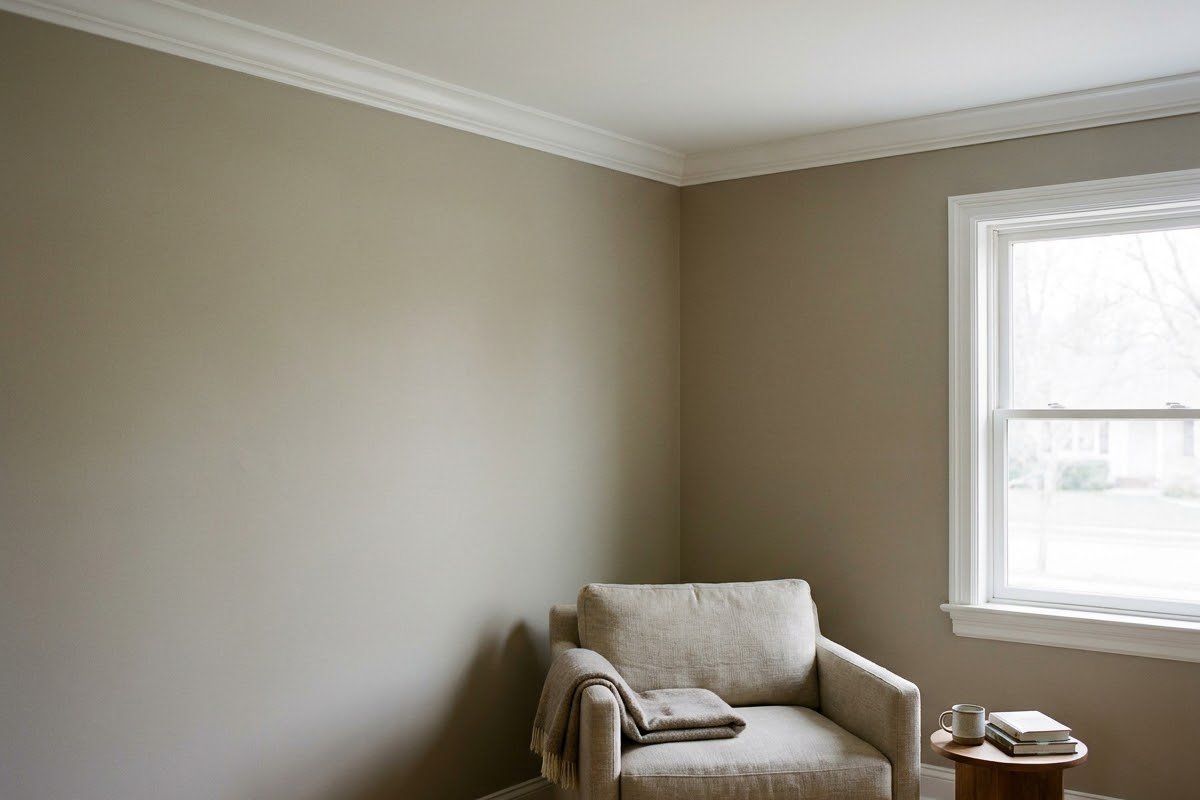
From the guide: Architectural Details That Define Luxury: Trim, Molding, and Millwork Worth the Investment
Crown molding is bought by the length, so the question is how many pieces. This guide shows the measuring and the arithmetic, and our online trim estimator does it for your room. It supports our guide to luxury trim, molding and millwork, which covers profiles, materials and proportion.
How much crown molding to buy
Add the length of every wall, then add 10%. A 12 by 14 foot room has 52 feet of wall and needs about 57 feet. That is four 16 foot pieces, five 12 foot pieces or eight 8 foot pieces, rounded up, as the worked example below shows. The 10% comes from a manufacturer’s measuring guide and a retailer’s instruction sheet, and it is a rule of thumb.
Measure the perimeter
Sketch the room and measure each wall along the ceiling line, tape tight into the corner, as Metrie suggests. Write down every wall and any bump-out, and include both sides of a bump-out. A rectangle is 2 × (length + width). For an L-shaped room or an alcove, add each wall. If you run molding around a pillar or an arch, include its outside corners in the measurement.
Inside and outside corners
Corners do not add to the measured length, but they use material. Metrie’s guide cuts one end of a piece at an angle, switches the saw to the opposite 45 degree setting for the other end, and reverses the cuts for an outside corner. A simple rectangle has 4 inside corners, and each bump-out adds outside corners. Count them so you know how many joints you will cut, and allow a little extra length for a trial cut. The calculator uses 2 inches per cut end as a planning assumption you can change.
Waste and stock lengths
Suppliers list crown in 8, 12 and 16 foot pieces, depending on profile. Divide the length with waste by the piece length and round up. A wall longer than the piece needs a scarf joint, and each joint uses a little more material. The calculator also tests a cutting plan, so it will recommend more pieces than the percent method when long walls need joints:
| Room | Walls | With 10% | 8 ft pieces | 12 ft pieces | 16 ft pieces |
|---|---|---|---|---|---|
| 12 × 14 ft | 52 ft | 57.2 ft | 8 | 5 | 4 |
| 16 × 20 ft | 72 ft | 79.2 ft | 10 | 7 | 5 |
Baseboard and casing
For baseboard, chair rail and wainscoting, subtract the width of door openings from the wall total before you add waste, as Metrie describes for chair rail and wainscoting. A 12 by 14 foot room with two 3 foot doorways has 52 − 6 = 46 feet, or 50.6 feet with 10%: 7 eight-foot, 5 twelve-foot or 4 sixteen-foot pieces. Casing is measured for each door and window from the height and width of the opening. Crown follows the ceiling line and is not reduced for openings.
Choosing a size
Length does not change with the size of the molding, but the cost per foot does. Metrie recommends crown of about 3 to 5-3/4 inches for 8 foot ceilings and about 3 to 7-1/2 inches for 9 foot ceilings, and more substantial crown for ceilings of 10 feet or more. See our guide on ceiling design ideas for how crown meets coves and coffers. If you plan recessed lights, set them out first with the recessed lighting layout guide.
Worked example: a 12 by 14 foot room
- Walls: 2 × (12 + 14) = 52 ft.
- With 10% waste: 52 × 1.10 = 57.2 ft.
- 16 foot pieces: 57.2 ÷ 16 = 3.58, round up to 4. The 14 foot walls need 14.33 feet and the 12 foot walls 12.33 feet with a 2 inch allowance per end, so each wall fits in one piece with no scarf joint.
- 12 foot pieces: 57.2 ÷ 12 = 4.77, round up to 5. Both wall lengths exceed 12 feet once the allowances are added, so each wall takes a scarf joint.
- 8 foot pieces: 57.2 ÷ 8 = 7.15, round up to 8, with scarf joints on every wall.
Use the calculator
Enter the room size, any extra wall run, outside corners and the piece length in the free trim quantity tool. It shows the percent method, the cutting plan and what 8, 12 and 16 foot pieces would each need. Pair it with the light count and spacing tool when you plan the ceiling as a whole.
Your questions answered
How much crown molding do I need for a 12 by 14 foot room?
The walls total 2 × (12 + 14) = 52 feet. Add 10% waste for 57.2 feet. That is 4 pieces of 16 foot molding, 5 pieces of 12 foot or 8 pieces of 8 foot, rounded up. Crown runs along the ceiling line, so you do not deduct doors and windows. Measure your own walls tight into the corners and round up, since a short piece is expensive.
How much extra crown molding should I buy for waste?
Plan on about 10%. Metrie recommends buying an extra 10% to cover underestimation, damage and bad cuts, and Menards' instruction sheet gives the same figure. It is a rule of thumb rather than a standard. Add more for a room with many corners, bump-outs or short walls, or if it is your first install. Offcuts are useful for test cuts.
Do inside and outside corners need extra molding?
Corners do not add to the wall measurement, but each corner uses material when you cut the angled ends. Metrie's guide cuts each end at roughly 45 degrees on a square corner and reverses the cuts for an outside corner. Count the corners, because each has two cut ends, and include pillars or arches in the measurement, as Metrie advises.
How do I join crown molding on a wall longer than one piece?
Use a scarf joint. Cut one piece at a 45 degree angle and fix it to the wall, cut the second at the opposite angle, lay it over the first with glue and nail it in place. Wipe off excess glue, let it dry and sand the joint smooth. Place the joint on a stud, and avoid very short pieces.
Should I buy 8, 12 or 16 foot molding?
Longer pieces mean fewer joints, and a 16 foot piece covers most single walls in a normal room without a scarf joint. Eight foot pieces are easier to carry and fit in a car but need many more joints on a long wall. Availability depends on the profile and the supplier, so check what your profile comes in before you plan.
How do I calculate baseboard and chair rail?
Use the same method with one change: subtract the width of doorways and other openings from the wall total, as Metrie describes for chair rail and wainscoting, then add 10% for waste. Casing is figured per opening, using the height and width of each door or window. Crown follows the ceiling line, so it is not reduced for openings.
References
- Metrie: Measuring a Room for Mouldings (metrie.com)
- Metrie: Crown Moulding Sizes (sizes by ceiling height, corners, scarf joints) (metrie.com)
- Menards / Dakota Trims: How to calculate project (midwest.menards.com)
- Baird Brothers Fine Hardwoods: MDF crown mouldings (8 ft and 16 ft) (bairdbrothers.com)
- Fine Homebuilding: Finger-jointed trim (16 ft lengths) (finehomebuilding.com)
More guides like this
- Architectural Details That Define Luxury: Trim, Molding, and Millwork Worth the Investment
Learn how to specify luxury trim, crown molding, and custom millwork using AWI grades, ceiling-height proportions, material specs, and real cost ranges.
- Designing Custom Built-Ins for Seamless Interiors
Plan custom built-ins with pro dimensions, Sagulator shelf span limits, AWI casework grades, CPSC wall-stud anchoring, and realistic DIY vs. pro costs.
- Architectural Details That Elevate Minimalist Interiors
Discover minimalist architectural details—shadow-gap baseboards, flush frameless doors, drywall window returns, and recessed trims—with real specs.
- Ceiling Design Ideas for Subtle Architectural Luxury
Compare coffered vs. tray ceilings, cove lighting setbacks, wood-slat acoustics, code height minimums, and realistic per-square-foot costs.
- How High to Hang Art: The 57-Inch Rule and Spacing Over Furniture
How high to hang a picture: the 57-inch centre rule, the 6 to 10 inch gap above a sofa, and the formula for where the nail goes, with worked examples.
- Recessed Lighting Layout: How Many Lights and How Far Apart
Plan a recessed lighting layout with the lumen method: how many lights a room needs, how far apart to space them, and how far to keep them from walls.